
KYC guide | Checked 18 September 2026
Gambloria KYC: Verification Documents, Checks & Withdrawals
 Available in AU
Gambloria requires identity verification and uses a risk-based KYC framework rather than one universal document checklist. Its current KYC policy describes three due-diligence levels: SDD for very low-risk cases, CDD as the standard verification process, and EDD for higher-risk customers, large transactions or special cases. Core categories include identity data, an actual passport or ID card, and proof of address such as a utility bill or bank statement not older than six months. Extra identity or payment evidence can be requested depending on the case. KYC matters directly to withdrawals because the operator can restrict service, payments or cashouts until identity is sufficiently established. This guide does not promise one fixed completion time: the dedicated KYC policy gives the KYC Team a 24-hour review target after upload, while another current official page describes typical verification as 24-48 hours.
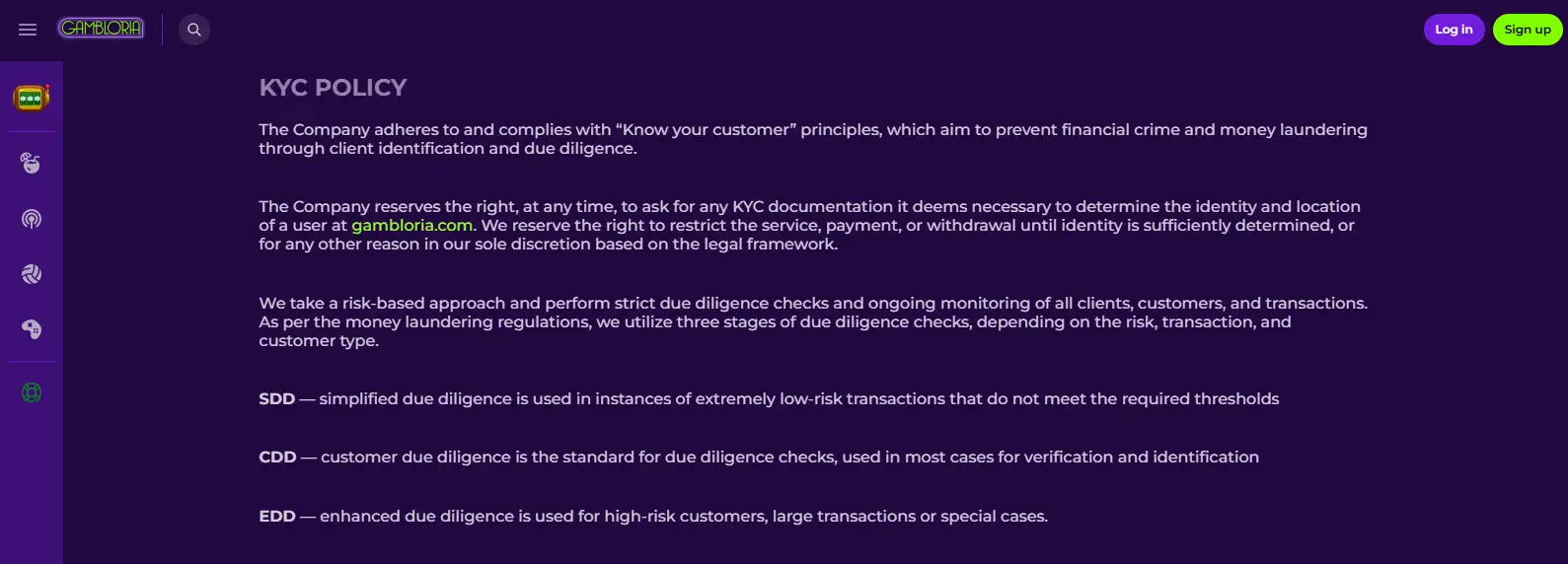
Table of Contents
- How Gambloria’s risk-based KYC model works
- Core identity information and documents
- Conditional extra checks: what can be requested
- KYC and withdrawals are directly connected
- Why this guide does not quote one KYC completion time
- How to prepare documents without inventing requirements
- Payment ownership and verification
- What happens when documents do not pass review?
- Australian context belongs outside the document checklist
- Sources checked for this guide
- FAQ
- What to prepare before Gambloria verification
How Gambloria’s risk-based KYC model works
The policy does not say every account follows an identical sequence. Instead, it says checks depend on risk, transaction and customer type. That is the key to reading the document requirements correctly. A list of possible documents is not the same thing as a list every player must submit.
| Level | Policy description | Practical meaning |
|---|---|---|
| SDD | Simplified due diligence for extremely low-risk transactions that do not meet required thresholds. | A lighter screening level for the lowest-risk situations described by the policy. |
| CDD | Customer due diligence used as the standard verification and identification process. | The normal identity-checking layer for most verification cases. |
| EDD | Enhanced due diligence for high-risk customers, large transactions or special cases. | More evidence or scrutiny can be required when the account or transaction context carries higher risk. |
This structure matters because it explains why two users can be asked for different evidence without the policy contradicting itself. The KYC process is designed to escalate when the risk profile or transaction context calls for more verification.
Core identity information and documents
The current KYC policy lists a minimum identity-data set that includes full name, date of birth, permanent residence address and an identification number. It then identifies the main document categories that can support those details.
- An actual passport or ID card as identity evidence.
- Proof of the current permanent residence address, with examples including a utility bill or bank statement.
- The address document is described as not older than six months in the current dedicated KYC policy.
Those are the baseline categories worth preparing for. They should also match the data in the account profile. The policy specifically lists mismatched name or address information, illegible copies, damaged documents and unreadable material as reasons a submission can fail review.
The key editorial distinction is that these categories come from the current official KYC policy, not from a generic casino verification checklist. The separate registration covers the registration information that should remain consistent with these later documents.
Conditional extra checks: what can be requested
Gambloria’s policy also lists additional evidence that can be requested depending on the screening level. Examples include another national identity document such as a driver’s licence, a readable photo of the user with an open passport, a bank-card front image showing the limited card details specified by the policy, and other documents requested by the operator. The general Terms separately allow verification evidence such as passport or ID, utility bills and payment-card evidence.
The Terms also allow further verification procedures during deposits or withdrawals, including a phone call to the number stored on the account. In the account-closing context, the Terms describe interviews and selfie-with-document evidence among the anti-fraud tools the operator can use. These are conditional powers, not a universal requirement that every player completes every listed step.
Do not turn examples into a mandatory checklist
The correct reading is: core identity and address evidence is part of the KYC framework, while extra ID, payment evidence, selfie-style evidence or phone contact can be requested when the operator’s risk and transaction checks call for them.
KYC and withdrawals are directly connected
Gambloria’s KYC policy says the company can restrict service, payment or withdrawal until identity is sufficiently determined. It also says users with a temporary approval status can normally use the platform while their ability to complete withdrawals is limited. The Terms reinforce that no withdrawal is processed until the required KYC and other checks are completed to the operator’s satisfaction.
This means a submitted withdrawal is not just a payment-method event. Identity review can sit in front of the payout stage. Once a withdrawal is successfully processed and released by the casino, the operator’s current Terms allow up to three business days for its own processing before the payment-provider stage. KYC delay and payment-provider delay should therefore be understood as separate parts of the timeline.
The full payout sequence, limits and method rules are covered on the withdrawal verification. Keeping the two topics separate avoids presenting the three-business-day operator processing window as a guarantee for total time from first document upload to funds arriving.
Why this guide does not quote one KYC completion time
Current official Gambloria pages do not give one perfectly aligned timing statement. The dedicated KYC policy says that after documents are uploaded and the account receives a “Temporarily Approved” status, the KYC Team has 24 hours to review them and email an outcome. A separate current Gambloria page describes the verification process as typically taking 24-48 hours.
Those statements may refer to different stages, but the sources do not settle that distinction clearly enough to support one guaranteed end-to-end completion time. The useful conclusion is procedural: submit clear matching documents promptly, watch the official account and email for the result, and do not plan a withdrawal around a guaranteed KYC turnaround.
This is one of the few places where precision would be misleading. A range copied from one page would hide the dedicated policy’s different review target, while the 24-hour policy line by itself would imply certainty the broader current site does not support.
How to prepare documents without inventing requirements
Good preparation means following what the policy actually says rather than guessing at file types, upload channels or image specifications that are not verified here. The official policy makes readability and matching account data important, so the practical checklist is straightforward.
- Check profile data first. Make sure the name, date of birth and address in the account are accurate before submitting evidence.
- Use current identity evidence. Prepare the passport or ID document requested by the verification workflow.
- Use current address evidence. The dedicated policy gives utility bills and bank statements as examples and uses a six-month age limit for that address document category.
- Keep images readable. The policy explicitly identifies illegible, damaged or unreadable documents as possible rejection reasons.
- Respond only to official requests. If an extra document, payment-ownership check or phone contact is requested, follow the instructions in the official account or operator channel.
- Do not redact blindly. A verification request can need specific visible details. Follow the current instructions rather than applying a generic redaction rule that makes the document unusable.
This page does not claim support for a particular PDF, JPEG or upload-size rule because those details are not part of the verified fact set used here.
Payment ownership and verification
Gambloria’s Terms require users to fund an account with personal payment methods and say the name on payment instruments used for deposits or payouts should correspond to the registered account name. That is why payment evidence can become part of KYC. Verification is not limited to proving that a person exists; it can also be used to establish ownership of the financial route connected to the account.
For an eligible account, the live Cashier remains the place where available methods and account-specific withdrawal limits are shown. The broader payments explains the platform method set without turning those methods into an Australia-specific availability claim.
What happens when documents do not pass review?
The KYC policy lists several possible reasons documents can fail: account information and document information do not match, copies are illegible or damaged, required identity details are not confirmed, or the evidence is not an accepted document for the requested purpose. The policy also says that when KYC is unsuccessful, the reason is documented and a support ticket is created, with the outcome communicated to the user.
Failure to pass KYC has direct account consequences. The current policy says a user who does not pass cannot make additional deposits or withdrawals. The Terms also preserve the operator’s ability to repeat verification checks and request further information when it considers that necessary.
The practical response to a rejection is therefore to correct the specific problem described by the operator, not to create another account. Duplicate-account rules can create a separate breach and complicate identity review further.
Australian context belongs outside the document checklist
KYC rules and Australian real-money eligibility are separate issues. Passing identity verification does not establish that an account is permitted to deposit or play from Australia. Current Gambloria Terms list Australia among Restricted Countries for real-money deposits and play. That geographic restriction is covered in more depth on the operator and licensing, rather than being repeated throughout this KYC guide.
For the broader product summary, return to the Gambloria review. This separation prevents a common mistake: treating a successful document check as a legal or geographic approval. KYC answers “who is the customer and does the evidence satisfy the operator’s checks?” It does not by itself answer “is this service permitted for this location?”
Sources checked for this guide
This page was checked against the current Gambloria KYC Policy and the current Terms and Conditions on 18 September 2026. A current official localized Gambloria page was also used only to confirm that a 24-48 hour KYC timing statement still coexists with the dedicated policy’s 24-hour review target. Because those timing statements are not identical, no fixed end-to-end KYC completion promise is presented.
FAQ
Does Gambloria require KYC?
Yes. The current KYC policy and Terms allow identity verification and link successful verification directly to withdrawal processing.
Which documents are part of the core KYC categories?
The current policy lists passport or ID and proof of address, with utility bills and bank statements given as address-document examples. The policy says requested documents depend on the screening type.
Does every player need a selfie or payment-card photo?
No universal requirement is stated. Those items are examples of additional evidence that can be requested depending on the case.
How long does Gambloria KYC take?
This guide does not give one guaranteed completion time because current official pages use different timing statements. The dedicated policy has a 24-hour review target after upload, while another official page says 24-48 hours is typical.
Can a withdrawal be processed before KYC is finished?
The current Terms say withdrawals are not processed until required checks are completed to the operator’s satisfaction.
What to prepare before Gambloria verification
Gambloria uses a risk-based KYC framework rather than one universal document checklist for every account. Identity and address evidence are core categories, while extra checks can be requested depending on risk, payment ownership and transaction context. Clear, current documents that match the account details are the most useful preparation, and withdrawal plans should allow for verification before casino-side payout processing begins. No single guaranteed KYC completion time is supported by the current official material used for this guide.
Prepared by the Gambloria Casino editorial staff.